Writing Hint #20 Get rid of clutter

I have declared the year 2007 as The Year to Get Rid of Clutter.

I currently do most of my writing in a room that used to be my son’s bedroom. When he left for university and married a few years later we converted this room into our office. Previously a corner of our own bedroom was the office area. Over the last ten years this “new” office has been well used. And it shows.

The clutter is – well, to be really honest – disgusting. Some writing magazines and occasionally a newspaper will feature author’s writing rooms, with the said writer posed romantically at his or her desk being very productive. Often these rooms are lined with bookshelves and everything seems so neat and proper. I can guarantee that each one of them had weeks of warning before the photographer arrived. They always seem so productive and sterile. I can also guarantee that reality is far from this pretty picture.

I have decided to start getting rid of all the clutter in my office. This is my theory: get rid of all that clutter and that will free my mind and energy so that it can be channelled into more creative pursuits.

Like writing.

So last week I started in ernest. The first object of my enthusiasm was the 30cm high pile of bank statements, old accounts (I was pleased to find that all had been paid), notes, jottings, miscellaneous pieces of paper, the odd magazine and the like. Many were filed in the nearby filing cabinet (which sadly also needs my attention). Some were shredded. In fact, hundreds of sheets went through the poor little shredder.

The next object of my newly found cleanliness fetish was the bookshelf above my desk. I have a lineup of a dozen or so magazine boxes. They have been crammed to overflowing with old magazines. Why I was keeping all those writing magazines I do not know. I had read every one of them. Some were more than ten years old. In a crazy wave of renewed enthusiasm to get rid of clutter I threw most of them out. Well – they are currently in a big box ready to take to a paper recycling centre.

Some of these magazines I did keep. The most recent two or three. Those which featured some of my writing were also kept. (Note to self: build an archives shed out in the back of the garage.) I also trolled through some for interesting articles to pull out for rereading. Not too many. They will also be shredded if I don’t use them in the next few weeks.

The next centre of attention was the comfortable chair near my desk. It is used for reading (and snoozing in when I get tired). It was covered in books, newspapers, unread magazines, travel brochures, maps, more accounts waiting to be filed and… well, you get the picture.

Still to be done:

  • Several boxes of assorted papers, folders, first drafts, correspondence and the like.
  • A large pile of unread newspaper literary pages.
  • A larger pile of unread literary, travel and nature magazines.
  • A daunting gathering of unread books on the bookshelves behind my desk.
  • An old, rarely used desktop PC that hasn’t been fired up for about six months. It dominates my desk; it needs to be archived too.

All this just makes me feel tired.

I think I need a little snooze – but my comfy chair still has a few things on it and there is no room on the floor.

Oh, the floor is cluttered too.
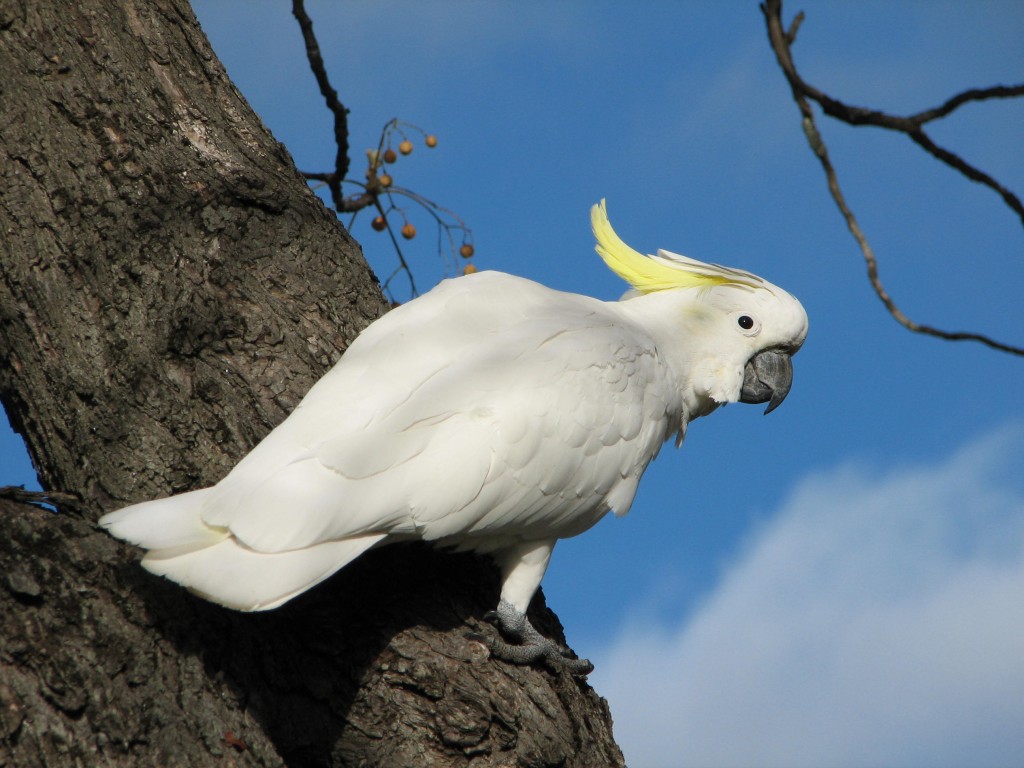
Haiku #30: Warning Call

Golden crests sunlit
Glow as cockatoos warn
Of an intrusion.

All rights reserved. Copyright 2007 Trevor W. Hampel.

Sulphur Crested Cockatoo

Sulphur Crested Cockatoo

Idiom #13: A feather in one’s cap

This week’s idiom:

“A feather in one’s cap.”

Meanings:

A special achievement or acknowledgment of one’s work or efforts is said to be “a feather in one’s cap.”

Origins:

A number of different cultures around the world celebrate victory over an enemy or the killing of an enemy by placing a feather somewhere on the head, as in the head-dress of the American Indians. Feathers still feature prominently in the ceremonial apparel of many cultures, from the highland chiefs in Papua New Guinea with their elaborate head-dresses made from the feathers of a Bird of Paradise through to the ostrich and heron feathers used in the cap of members of the Most Noble Order of the Garter in Great Britain.

Today, the common expression is used of anyone who has accomplished some special achievement.

Example:

  • Winning the seven year old race on Sports Day is certainly a feather in your cap.

Short Fiction #29 Boredom

Boredom

She trudged the last few steps towards the door. The downpour had made the bus trip home tiresome. The house looked cold and alone. The chilled air of the darkening sky swept into the room ahead of her.

“What a relief,” she sighed. “That old grinder of a bus won’t make it one day.”
She dropped her bags on the couch and went to pour a glass of sherry. She flopped onto the seat, reached for the controls and flicked on the TV.

“Boring,” she muttered. “What I need is some excitement. No chance of that!”

All rights reserved.

Copyright 2007 Trevor W. Hampel

How to write great content on your blog

One of the things that annoys me about many blogs is that the authors don’t bother to write their own articles. They just quote or link to others who have written articles that interest them.

Write original content

Yes, I’ve also done this from time to time, but usually when I consider that the author has said something really significant, or they have said it better than I possibly could. Sometimes it is purely a matter of time restraints. As much as possible I try to write original content on my blogs.

An example of original content

Writing original content is relatively easy for me. Firstly, I have the time to devote to researching and writing articles that appear on my blogs. It could also reflect the unique nature of my blogs. For example, my Birding Blog mainly features bird observations that I have made, illustrated by photos I have taken. Sometimes I will link to other blogs or web sites that I think my readers would be interested in looking at.

Unique content

On my Travel Blog I relate my experiences travelling in Australia and overseas. Again, the content is unique to me and this also features photos I have taken. I aim to not only make this blog read like a travel journal, which it sometimes is, but to also give my unique slant on the places I visit. I aim to give personal impressions of the places, the people, the culture and my reactions to these places.

Some sources for original content

On this, my writing blog, I frequently post snippets of my vast body of writing, including poetry and short stories. Many of my articles about writing and blogging (like this one) are quite original. I will admit that quite a few articles are prompted by what I have read in magazines, books, web sites or other blogs. I’ve even used ideas from radio and television programmes. I usually try to give my opinions or unique slant on these articles. This article, for example, was prompted by an article I read on ProBlogger. (More about that later.)

How to write great content

There are many different ways of doing this. How you do this will depend to some extent on the particular topic or theme of your blog. There are some general principles all bloggers can follow. This is by no means an exclusive list:

  1. Always write original content: Always relying on others for your content is a somewhat lazy way of building your blog. It can eventually turn off your readers because you rarely have anything new to say. Sure, writing original material is hard, time consuming and takes effort. If you are consistent and persevere with this approach, you will develop a loyal community of readers.
  2. Always write unique content: Write content that only you can write. Find a unique slant or unique responses to what you are writing about. In this way you will be bringing new thoughts and ideas to the conversation.
  3. Always be yourself: Print publishers, editors and writing mentors and writing instructors frequently talk or write about finding your own voice. Develop your unique style or voice in your writing, whatever its target audience. This takes time, effort and persistence. It will not happen overnight. The opposite, however, trying to copy the style of a famous writer or blogger, is a short cut to disaster. It just doesn’t work in the long term.
  4. Always add value if using content from others: If you do wish to refer to or link to the content of other bloggers, try to add value to what others have written. Give your own slant, your own opinions and unique response to what others have written about. A good example of this is this article; at the end there is a link to the source of the idea for this article. I just didn’t comment that the article is a good one, or that it makes good points on the topic. Instead, I gave my unique slant on the topic and in doing so, I hope that I have added value to the discussion.

Rules for writing great content:

Tony Hung, as a guest blogger on ProBlogger has written about what he calls the 1 / 9 / 90 rule of writing content. He explains it this way:

  • 1% of bloggers create new content (what I called original or unique)
  • 9% of bloggers enrich content (what I called adding value)
  • 90% of bloggers consume content

Of course, Tony’s article says far more than just that. Read the whole article here.