Idiom #19: As Free as a Bird

This week’s idiom: As free as a bird.

Most birds are free to go where they please. Unless they are in a cage or aviary, in which case they are not as free as a bird.

Meaning:

If someone is said to “be as free as a bird” they are able to go wherever they please without any restrictions or worries.

Example:

When Jenny left home and travelled through Europe without her parents, she was as free as a bird.
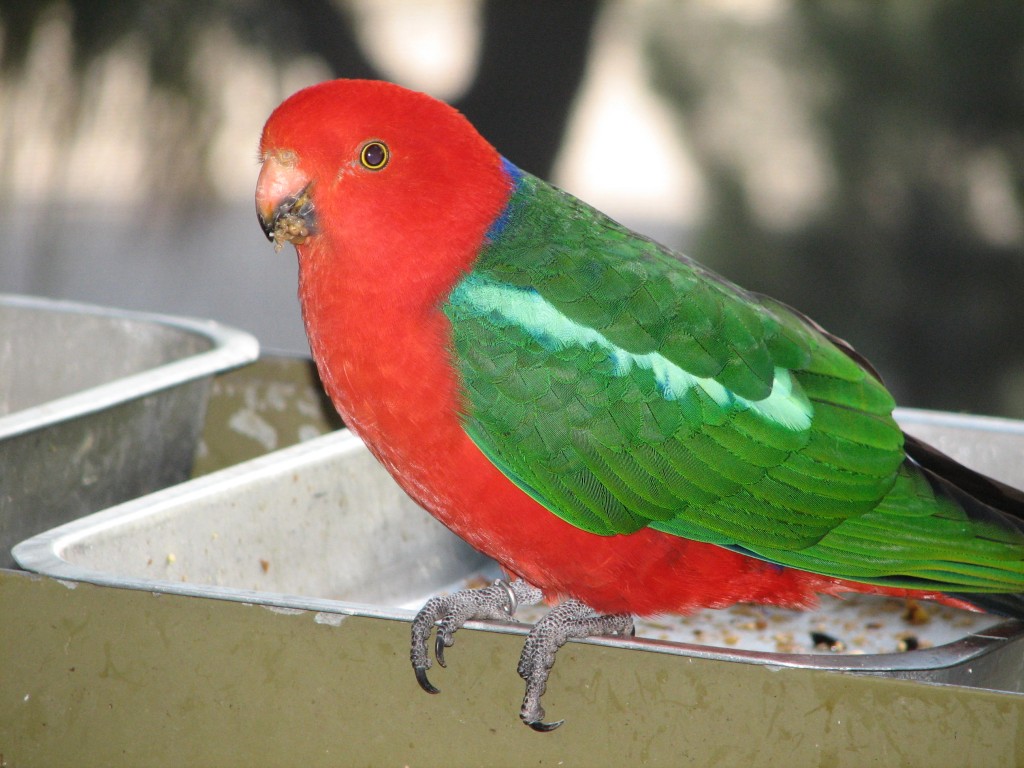
King Parrot at Adelaide Zoo

King Parrot at Adelaide Zoo

The bird shown in the photo above is not as free as a bird. The photo was taken inside a walk through aviary at the Adelaide Zoo, South Australia. King Parrots are found as free as a bird in the forests and woodlands of eastern Australia.

Click on the photo to enlarge the image.

See more bird photos – and much more – on my photo gallery here.

Read more about Australian Birds on Trevor’s Birding Blog here.

Read more about idioms here.

A wonderful thing about writing

“The beautiful part of writing is that you don’t have to get it right the first time, unlike, say, a brain surgeon. You can always do it better, find the exact word, the apt phrase, the leaping simile.”~ Robert Cormier

This is one of the beautiful things about writing. It is an art, not a science. There is so much to be creative about. It is exciting to start out with something in mind, only to find that a piece of writing, or a character, or a story plot takes over, creating an organic life of its own. I’ve had this happen on many occasions, even with blog articles.

Yes, I do plan what I am going to say, but sometimes I end up somewhere else entirely. With my short story writing I sometimes start with just the name of a character in mind. Then I mentally picture that person and ask myself, what is he/she doing? Why are they inhabiting my mind? What will they do with the “life” I have given them? Before I know it, this new “life” takes over, creating a little existence of its own.

Sometimes it doesn’t work like how I’ve described. That’s fine. Sometimes it is just a snatch of a conversation over heard, a memorable phrase or an amazing scene that is the leaping off point for a story. Sometimes I do know the ending from the beginning, and plan the plot accordingly. Often though, I enjoy the creative excitement of discovering the story as it unfolds.

It doesn’t always work. But that’s okay. It’s not brain surgery. I can go back over and rewrite – or even abandon the story completely.

I guess that’s why I choose to be a wordsmith – and not a brain surgeon.

Life is mostly froth and bubble

“Life is mostly froth and bubble,

Two things stand like stone,

Kindness in another’s trouble,

Courage in your own.”

Adam Lindsay Gordon, Australian poet.

I heard this quote last Sunday on the Australia wide radio programme, “Australia All Over.” Someone ringing in to the programme read out the whole poem which was quite beautiful. I have quoted only the last four lines.

These words are not only beautiful, they are heavily ironic when you realise the tragedy of the poet’s life. Adam Lindsay Gordon’s life was mostly “froth and bubble” as he dissipated a large inheritance from his mother on frivolous living. His first love was horses, both in breaking them and in riding them, interests that are strongly represented in his poetry.

As a horseman he received much recognition throughout the fledgling Australian colonies. Coupled with this was a growing reputation as a poet with several volumes to his credit at the time of his death. His interests were broader than this, and he even served a term in parliament.

He evidently had many trusted and supportive friends but even their kindness could not prevent the tragedies of his life. Financial mismanagement, personal loss such as the death of his only child and a reckless approach to many physical activities took their toll. His volume of poetry Bush Ballads and Galloping Rhymes was published on 23rd June 1870. The next morning he took his own life, age 37.

Sadly, the courage he wrote of in the poem I quoted above had deserted him.

Easy reading and the art of writing

“Easy reading is damn hard writing.” Nathaniel Hawthorne.

Writing that is easy to read is certainly hard to write.

Many misinformed people think they will start their writing career by writing picture book texts for children “because they are so simple they must be easy.” This assumption is totally wrong.

Have you ever tried to write a very simple text for four and five year olds with the following criteria?

  • Have a limited vocabulary
  • Write within a strict word count
  • Tell an interesting story
  • Be relevant to the needs and interests of children
  • Be age relevant
  • Be sparkling text
  • Be socially inclusive, non-sexist, non-racist and non-everything
  • Be innovative.

If you have, and been successful, then you don’t need to be reading this post.

In the early 1990s I wrote a series of texts for a publisher. These were for three to five year olds, and I know how difficult, challenging, exhausting and demanding it can be. Throw a publisher’s deadline into the mix and you will appreciate how hard it really can be.

With much practice in the art of writing you can make your writing appear easy.

It may appear easy, but the process is very hard.

Use your inbuilt story antenna

“Everybody walks past a thousand story ideas every day. The good writers are the one who see five or six of them. Most people don’t see any.” Orson Scott Card

Where do you get your story ideas from?

Do you have your eyes and ears open ready to receive story ideas, like some invisible antenna ready to receive the incoming messages?

Be on the lookout for story ideas everywhere you go, every person you see or listen to, snatches of conversation in the mall, the train, the television – if fact, wherever you are. Take a notebook with you and jot down those ideas, those words, the images you see. Record the sights, the smells, the sounds all around you and file them away for future use. Some of these jottings will never be used, others will be very useful and still others will be the gems that turn a good story into a great story.

Here are some examples:

  1. A white lily: I saw a white lily in the garden of a neighbour on my early morning walk. Write about what the memory of white lilies means to you about someone (friend or family) who recently died.
  2. A raven: A black raven flew over the house at sunset. Write a story about your cold feelings of impending disaster (death?).
  3. A rusty truck: Write about the joyful times you had on a favourite old truck on your uncle’s farm, and your sadness now that it is on the scrap heap.
  4. A singing bird: Write about the feelings you have when you hear a beautiful singing bird. What memories does it bring to mind? Who does it make you think of?
  5. The aroma of freshly baked bread or cake: Write about your favourite food, how it makes you feel and the memories it brings to mind.

Can you see the gem of an idea in any of these suggestions? If you can – start writing.

Make a list of twenty things you see on a walk around the block, or on your drive home from work or from the window of the train. Try to use as many of these things as you can in a story.

Remember: story ideas are all around you.

Good writing.